How 30 Seconds Can Change Your Life
I’m a serial mono-tasker.
While we now know that “multi-tasking” isn’t really a thing — it’s just our brains switching rapidly between tasks (more on that in a future post) — I take single-task focus to another level. When I’m in it, I’m in it. It doesn’t matter if it’s work, cleaning the kitchen, or watching a show — the rest of the world disappears.
And because of that, I don’t handle interruptions well. If my poor son pokes his head out of his room to ask a question while I’m mid-run on the treadmill, I’ve been known to snap before I even realize I’m speaking. Then, of course, comes the guilt spiral that lasts the rest of the night.
That hyperfocus can be useful in certain situations — like pushing through the last half mile of a workout — but when it shows up in open-ended, stressful settings like work, it becomes a problem. Time stops existing. My body’s cues to rest or reset get completely ignored.
Eventually, I realized it wasn’t just about focus — it was about regulation. My brain didn’t know how to take its foot off the gas once it was in go-mode.
So, I built myself a tool to help. (more about that later!)
When the Brain Forgets to Pause
Here’s what’s happening behind the scenes.
When you’re locked into a task — especially one that’s high-stakes, emotional, or uncertain — your stress response quietly turns on. Your amygdala, the part of the brain responsible for detecting threat, starts to dominate the conversation. It keeps you alert, scanning for problems, keeping that internal motor humming.
At the same time, your prefrontal cortex — the rational, creative, decision-making part — starts to fade into the background. You might feel productive, but in reality, you’re running on adrenaline. That’s why hours can pass without realizing it. You’ve essentially overridden the system that helps you notice you’re tired, hungry, or overwhelmed.
When that cycle repeats, it wires your brain to stay in “go” mode. The longer it runs, the harder it is to stop.
The Power of a Micro-Pause
A micro-pause is like a circuit breaker for that system — a way to cut the current before it overloads. It’s not a meditation or a long break. It’s a simple interruption that reminds your brain you’re safe.
When you pause — even for 20 or 30 seconds — your breath slows, oxygen levels rise, and your nervous system begins to shift from the sympathetic (“fight or flight”) to the parasympathetic (“rest and digest”). The prefrontal cortex comes back online. Focus and perspective return.
It’s like hitting “refresh” before your mental browser crashes. You don’t have to shut down the whole system — just clear the cache.
Why Micro-Pauses Actually Work
Our brains are masters of pattern recognition. Every time you insert a micro-pause, you’re teaching your brain a new pattern: that calm and clarity are available without a total stop.
Over time, this rewires your default stress response. Instead of being yanked around by every ping, deadline, or Slack notification, you start to regulate from within. You recover faster. You think clearer. You even start to notice moments of calm in places that used to trigger stress.
Micro-pauses are especially powerful for Type-A personalities and ambitious women in leadership — the ones who thrive on momentum but struggle to rest without guilt. Long meditations can feel impossible. But pausing for thirty seconds? That’s doable.
You know that moment when you finally get up from your desk, walk into the kitchen, and suddenly the solution to your problem hits you? That’s your brain, finally having enough bandwidth to connect dots that stress had disconnected.
The Problem with “Go Mode”
We’ve been conditioned to treat productivity as virtue. We wear exhaustion like a badge of honor. “Just one more email” feels harmless until it becomes a habit of self-neglect.
The problem isn’t focus — it’s forgetting to un-focus. The human brain isn’t built for endless forward motion. Without regular pauses, stress hormones build up, creativity tanks, and burnout becomes inevitable.
Traditional mindfulness advice often misses the mark here. “Just breathe” doesn’t land when your nervous system is running a corporate meeting in your head. You don’t need to escape the chaos — you need tools to regulate within it. That’s the whole philosophy behind micro-pauses: learning to access calm while the world keeps spinning.
Why I Built the Free Power Pause App
This is exactly what inspired me to create the Power Pause app.
After years of teaching yoga and mindset work to high-achievers, I kept hearing the same thing: “I know I need to slow down, but I don’t have time.” And honestly, I felt the same way. I didn’t need another thirty-minute meditation. I needed something that fit into the day I already had.
So I built it.
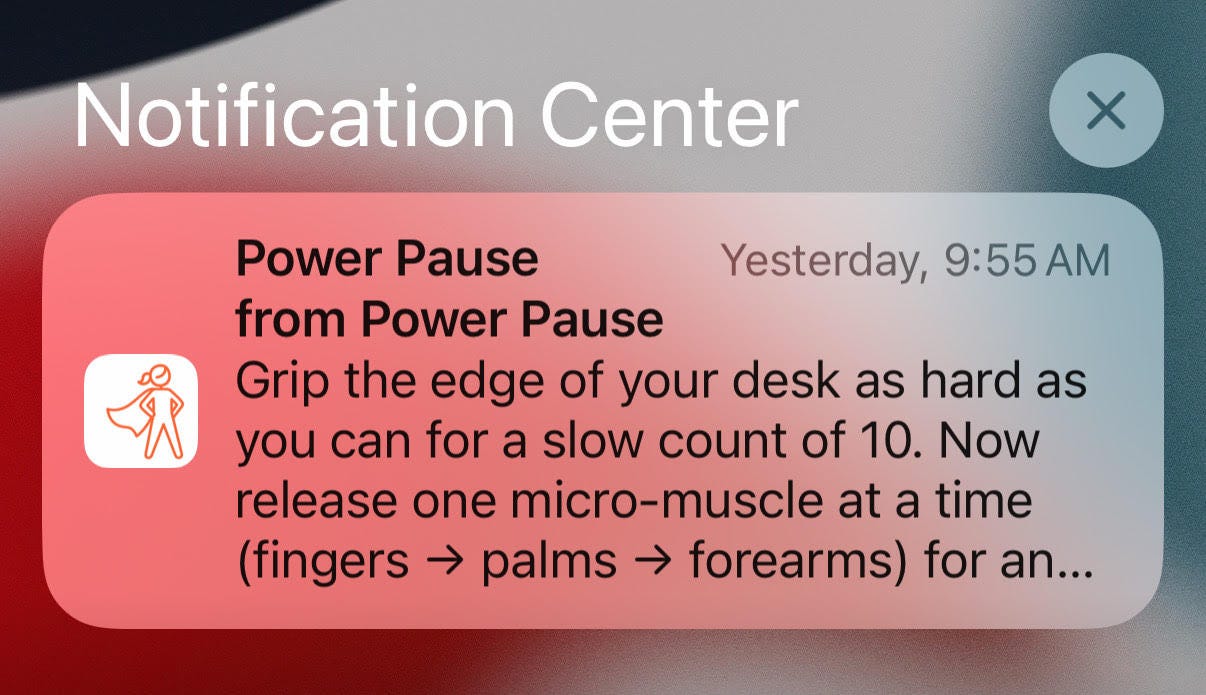
Power Pause delivers two quick prompts a day to whatever device you sign up on — one in the morning and one mid-afternoon — that invite you to stop, breathe, or reflect for just a few seconds. That’s it. Two guided moments to shift your state and retrain your nervous system.
Sometimes it’s a breathing cue. Sometimes it’s a video. Sometimes it’s just a reminder to notice how your shoulders feel. Each one is short, evidence-based, and designed for busy professionals who crave calm but don’t have the time (or patience) for long routines.
It’s not another app to check — it’s a reminder to uncheck from everything else. (it actually pops the reminders onto your notification screen, so don’t need to open an app at all!). If you want to see for yourself, head over to https://www.jenniferslis.net/free-app . It’s new and still in beta, so feel free to send me a DM with some feedback if you try it out!
Small Pauses. Big Results.
Micro-pauses aren’t about slowing down. They’re about staying in control of your pace.
Each pause is a vote for awareness — a moment to remember you’re not your calendar, your inbox, or your to-do list. And when you stack those moments day after day, something incredible happens: your default state shifts. Calm starts to feel familiar again.
So the next time your mind says, “Just finish one more thing,” try this instead: stop, breathe, and take a 20-second Power Pause.
Your next meeting can wait. Your nervous system can’t.
