

Why Your Morning Workout Might Be the Best Business Decision You Make All Day
What happens before the workday begins often determines how you show up in it.
Have you ever noticed how a problem that felt impossible at your desk suddenly seems manageable after a walk? Or how you can be spiraling in your head one minute—and strangely clear-headed after breaking a sweat or doing a few stretches?
That's not a fluke. That's your nervous system doing what it's was designed to do—once you get out of your chair and back into your body.
When you're stuck in a stress loop—mentally racing, physically tense, emotionally short-fused—it's not just in your head. It's in your nervous system. Chronic stress keeps you locked in fight-or-flight mode, where survival functions take over and the prefrontal cortex (the part of your brain responsible for big-picture thinking, empathy, and impulse control) goes offline.
Movement helps bring it back online—but not all movement works the same way.
If you've ever forced yourself through a high-intensity workout when your body was already drained and ended up feeling worse, you're not alone. The type of movement you choose matters because different kinds of movement affect the nervous system in different ways.
Studies show that aerobic exercise increases BDNF (brain-derived neurotrophic factor), a protein that helps your brain build new neural connections and recover from stress more efficiently. Cardio also triggers the release of dopamine and serotonin—neurotransmitters that improve mood, motivation, and focus. Rhythmic movement helps calm the amygdala, the part of your brain that sounds the internal alarm bell, making it easier to shift into a calmer, more regulated state. Even a brisk walk has been shown to boost creative problem-solving by more than 60%.
Here's how to match your movement to your stress state so you get the benefit you're actually looking for.
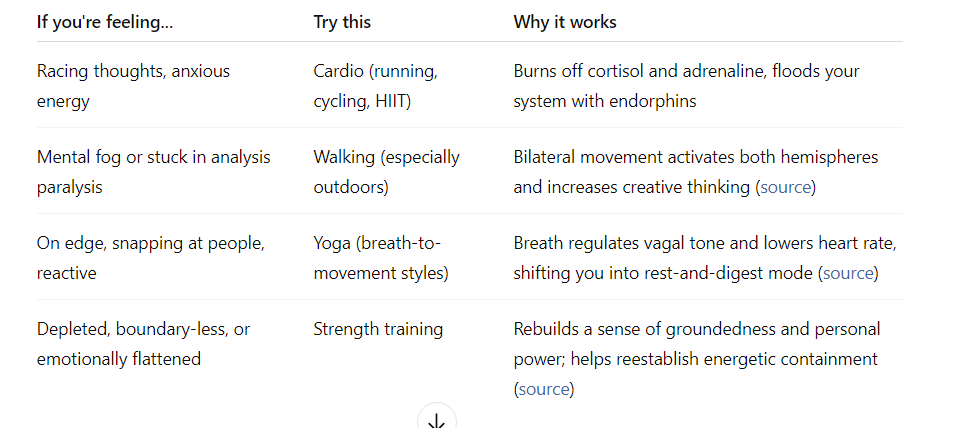
The goal isn't intensity. The goal is regulation. Movement is one of the fastest ways to shift your internal state so you can show up externally with more capacity, clarity, and composure.
How to Make It Work for Your Mornings (Without Adding Pressure)
Let's be honest—not every morning gives you 60 minutes to spare. But that doesn't mean the idea of a "morning workout" needs to be tossed out.
The value isn't in the number of minutes. It's in the signal you send your nervous system to begin the day in a different state than you ended the night.
Some mornings might give you space for a full training session. Others might only allow a few minutes between letting the dog out and jumping on a call.
Both count—if they're intentional.
Here's how it might look, depending on the kind of day you're having:
30–45 minutes of yoga, strength training, or a trail run to clear the slate.
15 minutes of movement to shift your energy and prime your brain before work.
On those barely-holding-it-together days? Just 5 minutes of intentional breathing and rhythmic movement to tell your body, We're safe. We've got this.
You're not doing it to check off another wellness box. You're building a leadership foundation that doesn't crumble when pressure hits.
Whatever form it takes, this is how you move from reactive to intentional, from chaotic to calm. And that shift doesn't happen in your inbox.
It happens in your body.
